So much has happened over the last two years, that it’s difficult to identify a clearly marked beginning.
One possibility is to share that it had been a difficult decision to move on my own to Rockford, IL for a job as an assistant professor of English. After the death of a friend the year before, I’d been haphazardly hanging onto academia by a thread, already applying for alt-ac jobs so that I could remain in Milwaukee, where I had been earning my PhD at UWM. Was it worth it to move away from partners, friends, and the local causes I cared about? I never felt confident either way but was often told it’s a lot easier to get out of academia than to get back in.
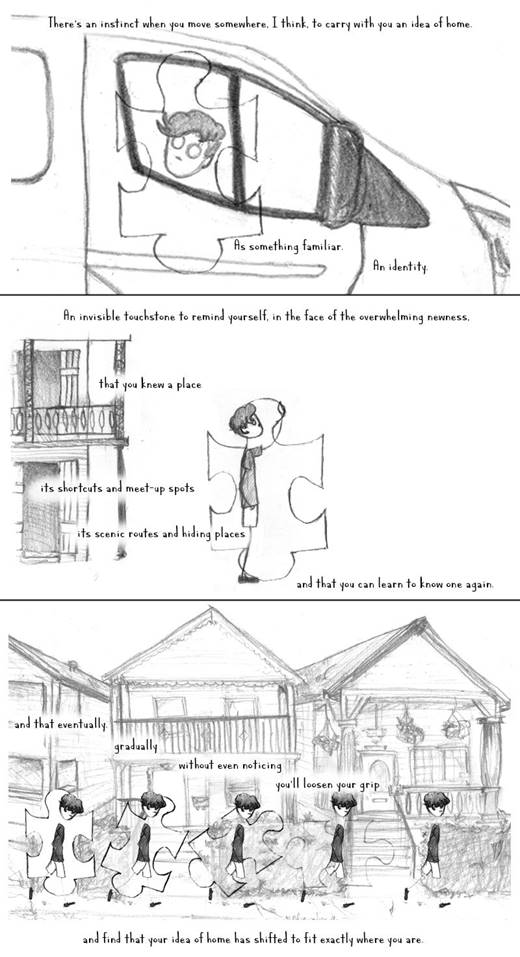
Another possibility for a beginning: in October 2019, my first semester teaching at Rockford University (RU), I taped a comic by Cameron from Autostraddle to my office door.
I set an intention to find my way and community in this new city.
Or maybe the beginning is later on, with the onset of COVID19 in March 2020: knowing it wasn’t in my best interest to quarantine alone, I packed up my suitcase, house plants, and cat to move back to Milwaukee with my partners. I didn’t see my Rockford apartment again until late July.
Perhaps the most important beginning, in retrospect, is June 2020: after the murder of George Floyd, I, like so many others, awakened to the fact that my past antiracist efforts hadn’t been enough. I had not been listening and learning enough, and I had not been courageous enough to speak and act out against racism in the ways I should have. I drove down small care packages of water, hand sanitizer, and masks to the Black Lives Protesters at Veterans Park in Milwaukee. I knew I needed to be braver and be a better ally and accomplice.
Or maybe all these various beginnings are less a linear starting point and instead an orbit: a trajectory leading me to better identify my sphere of influence, my resources, and what it is I am to do with my future after earning my PhD.
Whatever the case may be, one day in August, I found myself back in Rockford finishing up an inspection on a home I had just put an offer on. Like so many others living through the middle of a pandemic, I was seeking some semblance of grounding in a period of uncertainty. Homes were generally affordable in Rockford, and being divided between two cities exhausted my energy and resources, especially after the semester began and, with it, hybrid courses and long commutes.
After the home inspection was over, my partner and I drove downtown to the City Market, an outdoor venue with music and food, feeling the need to stretch our legs before the drive back to Milwaukee.
In that moment, I was too caught up in my own internal deliberation about whether to buy a house in and if this house was the right decision and if even academia really was the right decision, that I had neglected to remember there were ongoing Black Lives Matter protests in downtown Rockford and that the City Market was often selected for its visibility.
The energy at the market was so much different than the protests I had witnessed and attended in the larger city of Milwaukee. The protesting group was smaller and on occasion a car would drive by, blasting N.W.A.’s ‘Fuck tha Police’ or honking and cheering in support. It was also tense, with the police arresting and dragging off protesters without a clear reason. With each arrest, the mostly white group of people eating outside applauded, hoping that this would all end soon and that the market evenings would go back to normal.
I remember one moment in particular when a white man started yelling over the protestors’ chants, attempting to agitate and humiliate them. I was disappointed that I didn’t have the courage myself to confront him. I felt as though I was a witness or tourist to the city — that I had little to no agency, having been living in limbo over the last year.
Thankfully, another woman challenged him: after some heated discussion between them, he stopped taunting the protestors but continued to look over the market as if he was a soldier on guard.
These various beginnings, these forces of tension, these feelings of uncertainty have all converged and refracted, bringing me to today in April. Here and now, I am attempting to use my organizing power, privileges, and resources — many of which I have through my attachment to the university — to recognize and support activist efforts in the city of Rockford.
Most of this work so far had to be completed via Zoom or social media engagement, but I’ve tried my best to learn about mutual aid networks in the city and have partnered with community organizations, namely the Liam Foundation, who I’ve volunteered with over the last year. The Liam Foundation itself is a newer local LGBTQ+ resource center that has prioritized coordinated training and events centered on inclusivity and antiracism. I’m sure I’ve learned more about the city of Rockford through connecting with the leaders and volunteers there than I have anywhere else.
At RU, I’m also slowly getting to know other colleagues who share my values and interests, despite how difficult COVID has made this. For instance, a group of colleagues and myself have formed what we have recently called the Anti-Racism Alliance. Largely organized through RU’s Jane Addams Center for Civic Engagement, we’ve been meeting every week to talk about what kinds of long-term, sustainable anti-racist actions we can take as a university and how our efforts relate to the city at large.
To be honest, many of our Monday meetings leave us with more questions than answers: there are no easy actions, no one-size-fits all solutions, and no magic wand that could end white supremacy and it’s institutionalized reign in the city of Rockford nor at our university.
Despite all this, I try to keep in mind what Ibram X. Kendi writes in How to Be an AntiRacist: “No one becomes a racist or antiracist. We can only strive to be one or the other.” He continues: “Like fighting an addiction, being an antiracist requires persistent self-awareness, constant self-criticism, and regular self-examination” (23).
I see these meetings as an opportunity for our group to continue this striving.
We do, thankfully, also have some moments of success and joy in our alliance: for instance, our group has organized a continuing Courageous Conversations series centered on anti-racism and have plans to circulate a set of goals and objectives for the upcoming year with the rest of the university.
I’ll note here that I certainly don’t share all this because I believe these activist efforts could be attributed to me as an individual: that’s absolutely not the case. Instead, I share because of how they have helped me — in a time of so much turbulence — identify a sense of belonging to community.
Which brings me to one final possibility for a beginning: in February 2019, in a phone call with my advisor, I described how I was fearful academia would make me a worse person — that to stay in it I would need to embrace a certain form of ego that would put me in opposition to the issues I cared about the most. Or, alternatively, I would become so jaded and defeated that I’d grow eternally apathetic.
In a recent email exchange, she wrote to me: “I hope you have survived the past year with optimism intact — and energy to keep pushing toward most just systems.”
With this beginning I’ll end, or begin once more, in hope that we all have — and continue to sustain — such optimism, such energy.
*If you are able to, please consider making a contribution to The Liam Foundation and the 815 Mutual Aid Network.
*****
Kristin Ravel is an Assistant Professor of English at Rockford University (RU). Her research and teaching specialties include first-year writing, feminist rhetorics, digital media studies, and multimodality. She earned her LGBTQ+ and Inclusivity Workshop certificate from UWM in 2018, and her writing has appeared in Composition Studies, Bedford Bits, and the Sweetland Digital Writing Collaborative.
 Rhetoric Society of America